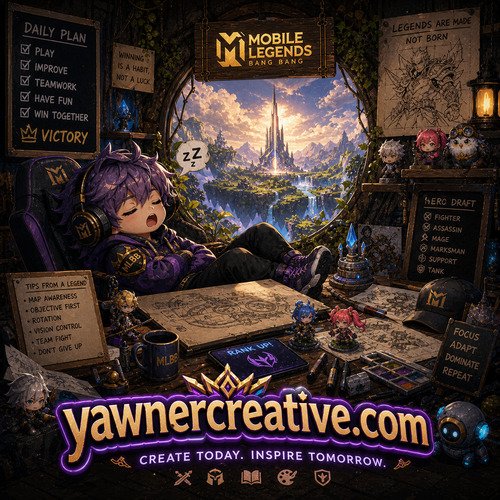
yawnercreative.com – In modern competitive gaming, Mobile Legends: Bang Bang stands out not only because of its fast-paced matches but because of how deeply its hero system shapes decision-making at every level of play. Heroes are not just tools for combat—they are expressions of strategy, identity, and adaptation. Each pick influences how the entire match unfolds, from early lane pressure to late-game objective control.
To truly understand the game, players must look beyond surface-level mechanics and begin interpreting heroes as systems of interaction. Every hero exists in relation to others, forming a dynamic web of strengths, weaknesses, counters, and synergies. Mastery comes from understanding this web and using it to control tempo, space, and decision-making across the map.
This article explores three advanced dimensions of hero mastery: strategic identity, counterplay intelligence, and ranked progression optimization.
Hero Diversity and Strategic Identity in Competitive Play
Every hero in Mobile Legends carries a distinct strategic identity that determines how they function within a team. These identities are not static—they evolve based on items, patch changes, and player execution. Understanding them is essential for building strong compositions and executing consistent gameplay.
Frontline heroes are responsible for shaping physical space on the battlefield. Tanks and durable fighters do not simply absorb damage; they control access points, dictate engagement angles, and force enemies into predictable movement patterns.
A strong frontline player understands that presence alone can disrupt enemy plans. By standing in river entrances, jungle choke points, or near objectives, they create invisible barriers that restrict enemy options. Even without engaging, they reduce the enemy’s confidence in moving freely.
Fighters add a slightly different layer to this identity. Unlike pure tanks, they often blend durability with sustained damage. This allows them to transition between initiating fights and applying pressure in sidelanes. Their flexibility makes them ideal for controlling mid-game tempo, where map movement becomes constant and unpredictable.
The true strength of frontline heroes lies in psychological pressure. Enemies are forced to consider not just current positioning, but potential initiation angles. This slows decision-making and creates hesitation, which can be exploited by more aggressive teammates.
Burst Identity: Assassins and Tactical Elimination
Assassins operate under a completely different philosophy. Instead of controlling space, they control threat elimination. Their goal is to remove key targets before a fight fully develops, often shifting the balance instantly.
This identity requires deep understanding of timing windows. Assassins cannot simply enter fights whenever they want—they must wait for conditions where enemy formation is disrupted or cooldowns are unavailable. Their impact depends heavily on patience and map awareness.
In advanced play, assassins also serve as information disruptors. Even when not visible, their potential presence forces enemies to reposition defensively. This creates indirect advantages for their team, such as freer objective control or safer rotations.
However, their fragility means mistakes are heavily punished. A poorly timed engage often results in immediate elimination. This high-risk identity makes assassins one of the most strategically demanding roles in the game.
Sustained Identity: Mages, Marksmen, and Utility Supports
Sustained identity heroes are the backbone of long-term engagement. Mages provide area control, burst zones, and wave management. Their abilities shape where fights can occur, often forcing enemies into narrow or disadvantageous positions.
Marksmen represent scaling inevitability. Their identity revolves around consistent output that becomes increasingly dangerous as the game progresses. While weak early, they become primary win conditions in late-game scenarios, provided they are properly protected.
Supports complete this system by enhancing survivability and enabling consistency. Their role is often underestimated, but they are essential for stabilizing fights and extending team durability. Healing, shielding, crowd control, and vision control all fall under their responsibility.
When these three identities function together, they form a stable damage ecosystem that allows teams to maintain pressure across all stages of the match.
Counterplay and Matchup Intelligence: Winning Through Knowledge
Beyond hero identity lies the deeper layer of counterplay intelligence. In Mobile Legends: Bang Bang, understanding how heroes interact against each other is often more important than mechanical execution. A well-informed player can neutralize stronger opponents simply through better decision-making.
Lane matchups determine early game stability and often influence mid-game momentum. Each lane interaction is a micro-battle where positioning, wave control, and ability timing define success.
Winning a lane is not always about securing kills. It is about controlling wave equilibrium, denying farm, and forcing the opponent into uncomfortable positioning. A player who understands matchup dynamics can often “win” without direct combat by simply controlling space and resource access.
For example, aggressive heroes may dominate early trades but struggle with wave management, while scaling heroes may avoid fights entirely but gain long-term advantage through safe farming. Understanding this balance allows players to adjust their behavior dynamically rather than following rigid patterns.
Smart laning also involves predicting jungle pressure. Recognizing when an enemy jungler is likely to gank allows players to adjust positioning and avoid unnecessary risks. This turns lane phase into a strategic prediction game rather than pure mechanical dueling.
Draft Counterplay: Structuring Advantage Before the Game Begins
Counterplay begins in the draft phase, where heroes are selected to directly influence enemy composition strength. A well-structured draft can neutralize threats before the match even starts.
Counterpicking is not just about choosing heroes that win lane matchups. It is about disrupting enemy win conditions. If a team relies heavily on one carry, selecting assassins or burst-heavy compositions can dismantle their entire strategy.
Similarly, teams with heavy dive potential can be countered with disengage tools, crowd control chains, or protective supports. The goal is not to out-damage the enemy but to invalidate their ability to execute their strategy effectively.
Draft intelligence also includes understanding synergy denial. Preventing enemy heroes from combining effectively is often more impactful than individual counterpicks. Breaking synergy reduces overall team efficiency and forces disjointed engagements.
Adaptive Itemization and In-Game Adjustments
Counterplay does not end after drafting—it continues through itemization and in-game adaptation. Choosing the right items based on enemy composition can drastically alter survival and damage output.
Defensive items against burst-heavy teams, anti-heal against sustain compositions, and penetration against tank-heavy setups all represent adaptive decision-making. These choices often determine whether a hero remains relevant in mid-to-late game fights.
Adaptation also includes gameplay adjustments. A marksman facing heavy dive pressure may shift positioning earlier, while a mage against mobile assassins may prioritize safer zoning rather than aggressive skill usage.
The ability to adapt mid-match is what separates reactive players from strategic ones. Instead of playing a fixed plan, adaptive players constantly modify behavior based on evolving conditions.
Climbing ranks in Mobile Legends: Bang Bang is not just about winning individual matches—it is about building systems of consistency. Hero selection, mental discipline, and role understanding all contribute to long-term progression.
Building a Reliable Hero Pool: Depth Over Randomness
One of the most common mistakes in ranked play is overextending hero variety without mastery depth. A strong hero pool is not large—it is efficient.
Players should focus on a set of heroes that cover multiple roles and scenarios. This ensures flexibility without sacrificing mechanical consistency. Each hero in the pool should serve a purpose: early pressure, scaling potential, or counterpick utility.
Depth matters more than variety. A player who deeply understands a small number of heroes will consistently outperform someone who plays many heroes at a shallow level. Mastery includes understanding matchups, power spikes, positioning, and decision-making patterns.
A well-structured hero pool also reduces decision fatigue. Instead of constantly adapting to unfamiliar mechanics, players can focus on macro decisions and map awareness.
Solo Queue Strategy: Independence and Controlled Impact
Solo queue requires a different mindset compared to coordinated team play. Since communication is limited, players must rely on consistency, self-sufficiency, and controlled aggression.
The most successful solo queue players focus on impact roles—heroes that can influence multiple lanes, secure objectives, or create picks independently. This allows them to reduce reliance on teammates while still contributing meaningfully to the match.
Map awareness becomes even more critical in solo queue. Without reliable coordination, players must constantly interpret enemy movement and predict team behavior. This transforms gameplay into a constant risk assessment process.
Winning in solo queue often comes from minimizing mistakes rather than maximizing flashy plays. Controlled aggression, safe rotations, and consistent objective participation are more valuable than unpredictable high-risk plays.
Mental Stability and Long-Term Competitive Growth
Beyond mechanics and strategy, mental stability plays a crucial role in rank progression. Emotional decision-making often leads to inconsistent performance, while calm and structured thinking leads to steady improvement.
Players who maintain focus across multiple matches tend to recognize patterns in their gameplay, such as recurring mistakes or inefficient rotations. This awareness allows continuous improvement over time.
Losses should be viewed as information sources rather than setbacks. Each match provides insight into positioning errors, drafting mistakes, or poor timing decisions. Players who analyze these patterns improve faster than those who simply queue repeatedly.
Ultimately, consistency is built through discipline, not momentum. Players who maintain structured habits—hero focus, role clarity, and decision awareness—climb more reliably than those relying on short-term performance spikes.
Conclusion Hero Mastery and Strategic Depth in Mobile Legends: Identity, Counterplay, and Competitive Growth
Heroes in Mobile Legends: Bang Bang form a deeply interconnected system where identity, counterplay, and progression all influence long-term success. Understanding heroes means understanding not only their abilities but also their strategic purpose within the larger ecosystem of the game.
From frontline space control to assassin precision, from draft-level counterplay to adaptive itemization, every layer of gameplay contributes to overall performance. True mastery is not defined by isolated mechanics but by the ability to connect decisions across all phases of the match.
Players who develop structured hero pools, understand matchup dynamics, and maintain mental discipline consistently outperform those who rely on instinct alone. In the end, success in Mobile Legends is not just about playing heroes—it is about mastering the logic behind how they shape the battlefield.
